- (800) 416-8102
- info@nativepartnership.org
- 16415 Addison Rd, Suite 200, Addison, TX 75001-3203

Navajo Mountain Elder Reflects on Community, Tradition, and Resilience
By Alicia Searfoss
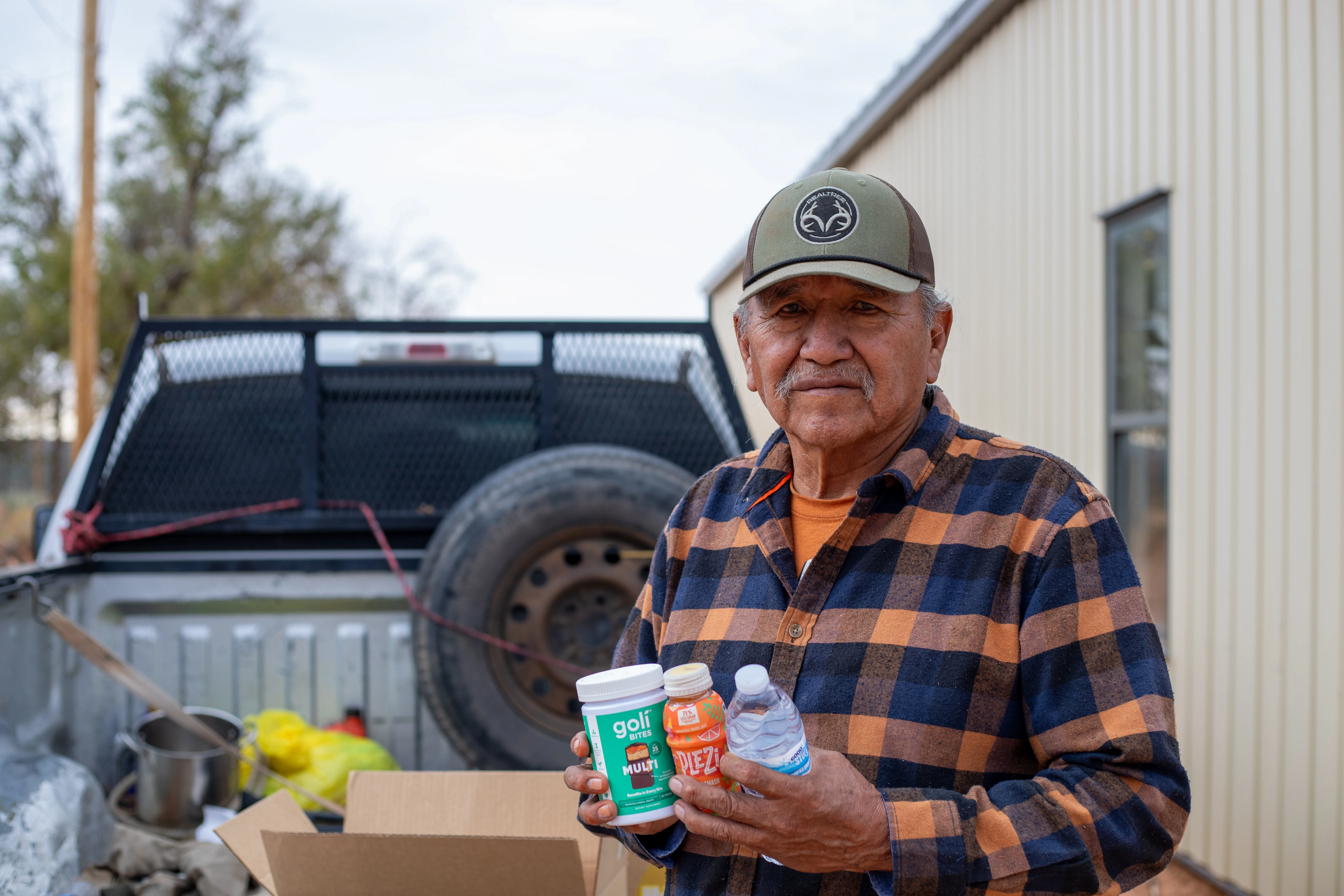
“They say it’s the head of the Earth,” said 74-year-old Keith K., pointing to the dome-shaped Navajo Mountain, which towers over the rugged valley below. “It’s not one of the Four Sacred Mountains of the Navajo Nation, but it’s still sacred,” he added. Known in the Diné language as Naatsisʼáán, Navajo Mountain gives its name to the remote community in southern Utah where Keith has lived his entire life.
Though the mountain holds deep cultural significance for the Navajo people, Keith acknowledged the San Juan Paiute’s long-standing roots in the area, which was once part of the Paiute Strip Reservation. Today, Navajo Mountain is home to both Navajo and San Juan Paiute families. Intermarriage has created a unique blend of traditions, with many households honoring both Tribal cultures.
Keith is a regular at the Navajo Mountain Senior Center in Arizona, operated by Fannie M., a Program Partner with Partnership With Native Americans® (PWNA). Recently, Keith was among 60 Elders in the Navajo Mountain Chapter to receive an Emergency Food Box from PWNA’s Navajo Relief FundTM (NRF) program. These boxes, filled with shelf-stable food, water, and cleaning supplies, arrived just in time for those struggling with rising costs and limited resources.
“Cost-wise, the food box definitely helps,” Keith shared. “Food is so expensive these days, so something like this really makes a difference.” Accessing groceries is no small task for residents. The closest trading post is 30 miles away in Inscription House, but its selection is limited. For better options, Keith travels 82 miles to Kayenta or 90 miles to Page, Arizona, where there is more variety and lower prices.
Living in such an isolated community presents challenges, but Keith remains deeply connected to Navajo Mountain. “I like living here. It’s nice and quiet,” he said. “I was born across the canyon on Paiute Mesa. I grew up herding sheep, hauling firewood, and carrying water for my elderly grandparents.” His wife, Ella, was also born and raised in Navajo Mountain. Though retired, she returned to work as a language and cultural instructor at the local school to address the teacher shortage.
Keith has taken pride in building the community over the years. Alongside other lifelong residents, he helped install the first electrical systems in the 1970s, paved roads and set up telecommunications towers on the mountain.
Though it comes with challenges, passing down cultural traditions is important to Keith and Ella. “Most parents talk to their kids in English,” Keith explained. “We try to encourage them to speak Navajo, but not everyone does. As a result, most of the kids primarily speak English.”
Despite the difficulties of preserving their language and traditions, Elders like Keith are proud to endure and thrive in the land they hold so dear. He expressed gratitude for NRF donors who helped during tough times. “It’s good that you are helping us when we need it. Thank you,” Keith shared. “I appreciate that [NRF] is providing these things for us.” Donate to NRF to support Elders across remote Tribal Nations.