- (800) 416-8102
- info@nativepartnership.org
- 16415 Addison Rd, Suite 200, Addison, TX 75001-3203

A Legacy of Service: Native Americans in America’s Military History
By Joshua Arce
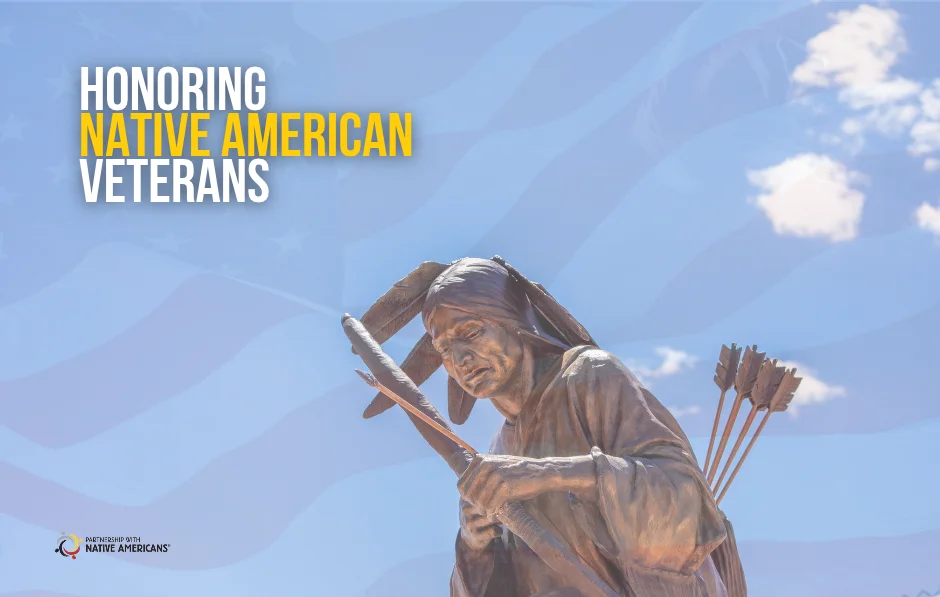
Native Americans have a long and complex history of military service in what is now the United States. Long before the country was founded, Indigenous nations had their own warrior traditions and histories of defending their homelands. As the United States developed, Native Americans became involved in its military conflicts in many different ways, serving as allies, soldiers, scouts, and, eventually, code talkers.
During World War I and World War II, Native servicemen made particularly significant contributions by using their Indigenous languages to protect military communications. Today, the stories of the Choctaw, Comanche, Navajo, and other Code Talkers are an important part of American military history.
As the United States celebrates its 250th anniversary, their stories offer an opportunity to recognize the many Native nations and individuals who have helped shape the country’s history.
Native American Military Service in the Early United States
Native American involvement in American military conflicts dates back to the Revolutionary War. Indigenous nations made their own decisions about whether to support the American colonies or the British, often weighing those alliances against their interests in protecting their lands and sovereignty.
During the War of 1812 and the Civil War, Native Americans continued to serve on opposing sides of military conflicts. Some fought alongside U.S. forces, while others defended their nations against American expansion. During the Civil War, Cherokee leaders Stand Watie and Ely S. Parker became notable figures on opposite sides of the conflict.
Following the Civil War, the U.S. Army formally established Indian Scout units in 1866. Native American scouts served alongside military forces, using their knowledge of local terrain, tracking, and survival skills. These units remained active into the 20th century, with the last Army Indian Scout retiring in 1947.
World War I: Indigenous Languages Become a Military Advantage
By World War I, thousands of Native Americans were serving in the U.S. Armed Forces. More than 8,000 Native American soldiers served during the conflict, many volunteering despite not yet being recognized as U.S. citizens under federal law.
It was also during this war that Native American languages first became an organized tool for secure military communications.
In 1918, Ho-Chunk soldiers Robert Big Thunder and John Longtail used their language to transmit military messages in France. Cherokee soldiers also used their language to communicate during the war.
Perhaps the best-known effort came from the Choctaw Nation. In October 1918, American forces were struggling with German troops intercepting their communications. An officer with the 142nd Infantry Regiment recognized an opportunity when he heard Choctaw soldiers speaking their language. He arranged for them to transmit military messages over field telephones.
Eighteen Choctaw soldiers participated in the organized effort, relaying information about troop movements, artillery positions, and battlefield operations. Their communications helped American forces coordinate military maneuvers against German troops.
Other Native American servicemen, including Comanche, Cheyenne, Osage, and Yankton Sioux soldiers, also used their languages for military communications during World War I. These early efforts revealed how Indigenous languages could protect sensitive information from enemy interception.
World War II: The Expansion of Code Talker Programs
The success of the Choctaw soldiers during World War I helped establish a foundation for the code-talking programs developed during World War II.
When the United States entered the war, military leaders recruited Native American servicemen from several nations to use their languages for secure communications. The Army and Marine Corps developed different programs, drawing on the linguistic knowledge of Indigenous soldiers serving in Europe, North Africa, and the Pacific.
Among the Army’s early recruits were Comanche, Meskwaki, Chippewa, and Oneida speakers. Eight Hopi speakers were later added to their code-talking efforts.
The Comanche Code Talkers served with the 4th Infantry Division in Europe. Their communications supported Allied operations, including the D-Day invasion of Normandy in June 1944. They developed specialized code words for military terminology, allowing them to transmit battlefield information that German forces could not decipher.
Meskwaki servicemen also contributed to communications during the North African and Italian campaigns. Their story, like those of the Chippewa, Oneida, and Hopi soldiers, demonstrates how servicemen from numerous Indigenous communities played important roles in the war effort.
Meanwhile, the Marine Corps developed its own code-talking program using the Navajo language. Beginning with 29 recruits in 1942, the program grew to include more than 400 Navajo Code Talkers. They developed a specialized code based on their language and transmitted messages across the Pacific, supporting critical military operations from Guadalcanal to Iwo Jima.
Other Indigenous languages, including Choctaw, Cherokee, Creek, Seminole, and Sioux, were also used for military communications during World War II.
Together, these servicemen demonstrated how the linguistic knowledge of Native communities could become an invaluable military resource.
A Legacy That Continues Today
Despite their contributions, many Native American code talkers did not receive widespread recognition immediately after the wars. Their communications programs remained classified for years, and many returned home without public acknowledgment of their service.
In 2001, the Navajo Code Talkers received Congressional Gold Medals in recognition of their contributions. In 2008, Congress passed the Code Talkers Recognition Act, and in 2013, 33 Indigenous nations were honored with Congressional Gold Medals for their code talkers’ service.
Native American military service also continued through the Korean and Vietnam wars, the Gulf War, and more recent conflicts. Native servicemen and women have continued to serve in the U.S. Armed Forces, carrying forward a long history of military involvement while maintaining their connections to their Tribal nations and communities.
Honoring Native American Veterans by Supporting Native Communities
This Veterans Day, we honor the Native American veterans who have served in the U.S. Armed Forces across generations. Their contributions are an important part of both Native history and the nation’s story. Honoring their service also means supporting the communities, families, and cultures they come from. Here are a few ways you can make a difference:
- Learn and share Native history. Take time to learn about the contributions of Native veterans from different Tribal Nations and share their stories with others.
- Support Native-led organizations. Donate to or volunteer with organizations that serve Native veterans, strengthen Tribal communities, and preserve Native cultures.
- Invest in Native communities. Support programs that address essential needs such as food security, housing, education, and access to resources.
- Recognize Native veterans locally. Attend Veterans Day events, listen to veterans’ experiences, and support recognition efforts in nearby Tribal communities.
- Support Native-owned businesses. Choose Native-owned businesses, artists, and creators, helping strengthen local economies and support self-determination.
At Partnership With Native Americans (PWNA), we work alongside Native communities to help address critical needs and support stronger, healthier futures. By learning, giving, and taking action, we can honor Native veterans not only for their service, but also by investing in the communities they call home.